Trade · Domaines Vinsmoselle
A journey through the wine collection
A closer look at the different wine ranges
Five brands, three ranges, vineyard slopes and geographical units: the wines of Domaines Vinsmoselle come in many variations from one vintage to the next, distinguished above all by their flavours, production methods and criteria. Together with André Mehlen, Director of Domaines Vinsmoselle, we take a closer look at the different wine ranges.
Domaines Vinsmoselle was established in 1966, “although the first winegrowers’ cooperative on the Luxembourg Moselle actually dates back to 1921,” André Mehlen points out. In 1966, the cooperatives of Greiveldange, Remerschen, Stadtbredimus, Grevenmacher and Wellenstein joined forces under the Vinsmoselle name. Wormeldange, with Caves Poll-Fabaire, only joined Domaines Vinsmoselle in 1989. Today, this association brings together around 150 winegrowers, covering 450 hectares of vineyards and producing between 4 and 4.5 million litres of wine and Crémant each year.
From Schengen in the south to Mertert in the north, the vineyards stretch across the sun-drenched slopes of the Moselle Valley, drawing their character from the specific properties of their respective soils.
Production Specifications to Meet
Like other wine estates, Domaines Vinsmoselle offers various wine ranges, each expressing its own flavours, techniques and expertise, providing a broad selection to suit the diverse tastes of its customers.
First come the entry-level wines, which carry no particular designation and are mainly recognisable by their light, fruity flavours. For a wine to qualify for this category, yields must not exceed 100 hectolitres per hectare.
Next come the Premiers Crus, mid-range wines whose yields must not exceed 85 hectolitres per hectare, André Mehlen explains.
Finally, the Grands Premiers Crus make up the premium range. They meet the most demanding production specifications, including yields limited to 75 hectolitres per hectare, manual harvesting and specific vineyard management practices. Produced from precisely defined plots, they may come from old vines or be aged in oak barrels. However, all three ranges are not necessarily represented within each of the Domaines Vinsmoselle brands.
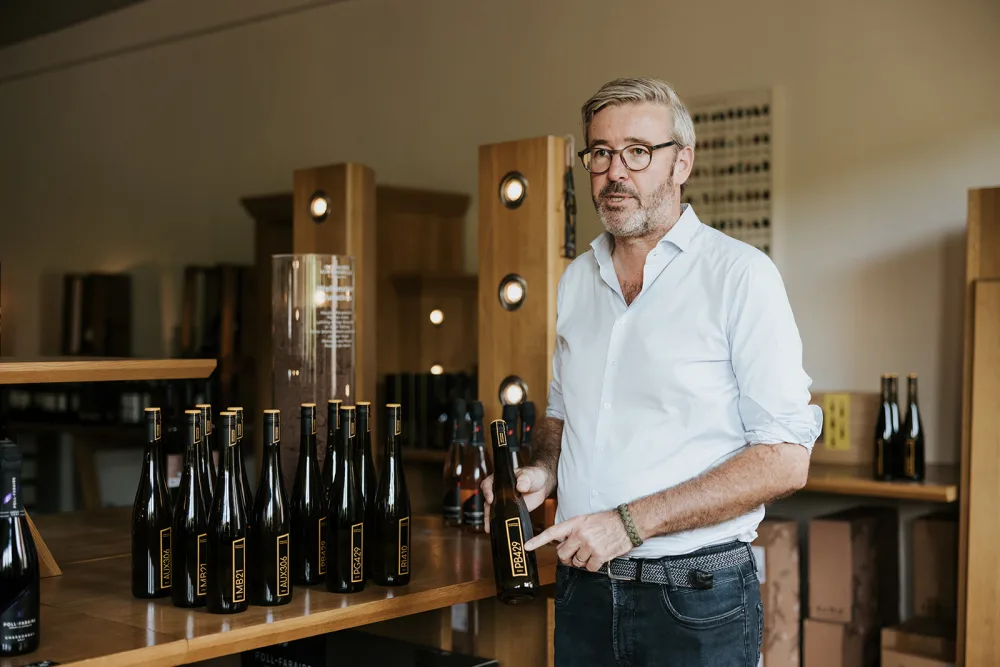
“The Grands Premiers Crus make up the premium range. They meet the most demanding production specifications.”
Brands that speak for themselves
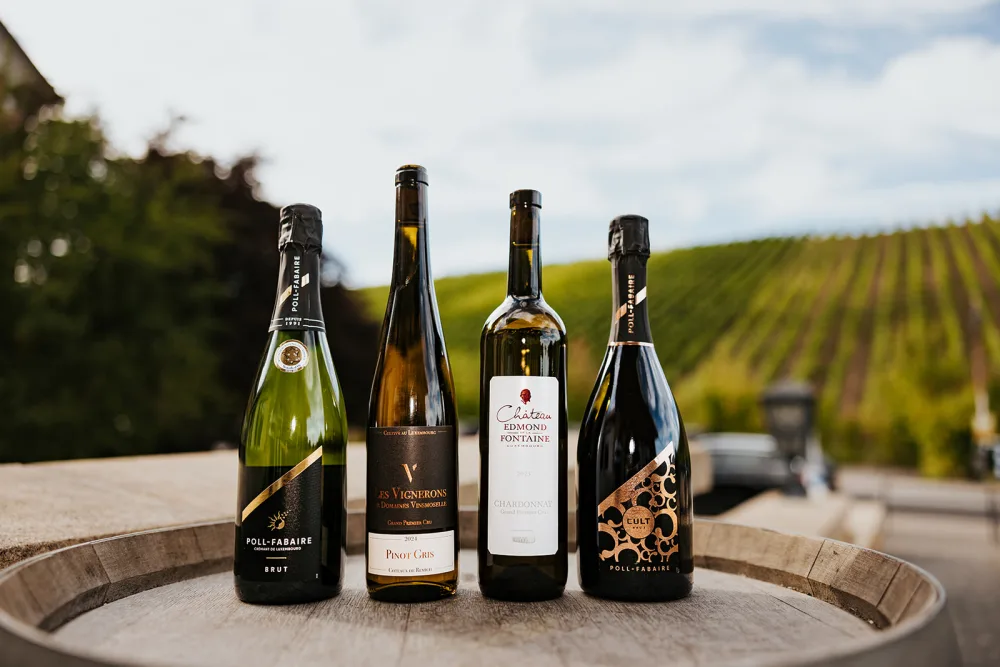
Les Vignerons des Domaines Vinsmoselle is the cooperative’s best-selling brand and is mainly available in supermarkets. It highlights the expression of each grape variety through carefully crafted wines with a clear, distinctive profile, offering unbeatable value for money. It is the only brand to offer all three quality levels: entry-level wines, Premiers Crus and Grands Premiers Crus, allowing everyone to choose according to their preferences and budget.
Recognisable by its Bordeaux-style bottle, Château Edmond de la Fontaine focuses on Burgundy grape varieties, particularly Pinot Gris, Pinot Noir and Chardonnay. On this subject, André Mehlen explains: “More and more winegrowers need supermarkets. Indeed, consumption habits have changed: people drink less, and the vast majority no longer have a wine cellar at home. They therefore tend to buy more spontaneously. For our part, we need to be able to offer wines where people do their shopping. And today, wines of all quality levels can be found in supermarkets.”
“Consumption habits have changed. People buy more spontaneously. So we need to be present where they do their shopping, including supermarkets.”
The Jongwënzer brand is positioned in the premium segment, featuring wines carefully selected through blind tastings by the cooperative’s young winegrowers. Its modern, minimalist packaging catches the eye, while its screw cap, practical for everyday use, is an increasingly appreciated selling point. The code on the label combines the initial of the grape variety with the number of the barrel from which the wine originates.
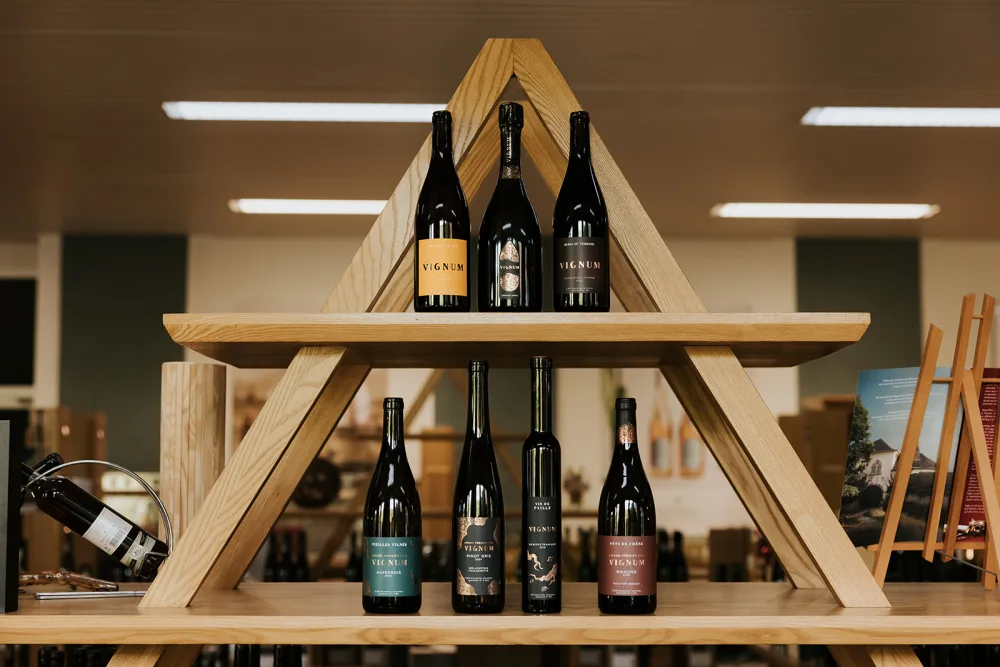
Finally, Vignum is the flagship range of the winegrowers of Domaines Vinsmoselle. It follows even more demanding production specifications, with vineyard inspections and restricted yields. Only wines from precisely defined vineyard sites are eligible. Each cuvée thus expresses the character of its terroir, but also the expertise of the winegrowers and cellar masters, whose work is an integral part of this identity. For each vineyard site, the wines are produced in limited quantities and the bottles are numbered. They are available exclusively in restaurants and at Domaines Vinsmoselle wine shops.
“To qualify for a geographical unit designation, the European Union requires that 85% of the wine actually comes from the geographical unit indicated. However, at Vinsmoselle, our requirements are stricter, as we insist that 100% of the wine comes from the geographical unit in question,” André Mehlen adds. It is also possible to specify the geographical origin in greater detail through the notion of terroir.
And the Bubbles…
Crémants are mainly found under the Poll-Fabaire brand, “a designation that dates back to 1991 and therefore celebrates its 35th anniversary this year,” adds the Director of Domaines Vinsmoselle.
“Poll-Fabaire Crémants come as Brut Nature, Extra Brut, Brut and Demi-Sec.”
These Crémants, made using the traditional method from a blend of several grape varieties, are available as Brut Nature (less than 3 g/l of sugar, with no sugar added after the second fermentation), Extra Brut (between 0 and 6 g/l), Brut (less than 12 g/l) and Demi-Sec (between 32 and 50 g/l). The range also includes Poll-Fabaire Cult, a Crémant distinguished by being made from Pinot Noir vinified as a white wine and aged on its lees for at least two years, as well as the Cuvée Millésimée, made from a blend of Pinot Blanc and Riesling that has spent a minimum of 24 months on its lees.
The Vignum brand also offers a Crémant made from two grape varieties (75% Chardonnay and 25% Pinot Blanc) and aged on its lees for five years. Each of these Crémants has its own distinctive characteristics.
Through this wide variety of ranges, Domaines Vinsmoselle offers a highly diverse selection of still and sparkling wines. Much to the delight of consumers! For further details, visit www.domainesvinsmoselle.lu.