Portrait · Ahn, Ehnen & Wormeldange
Four Houses, One River
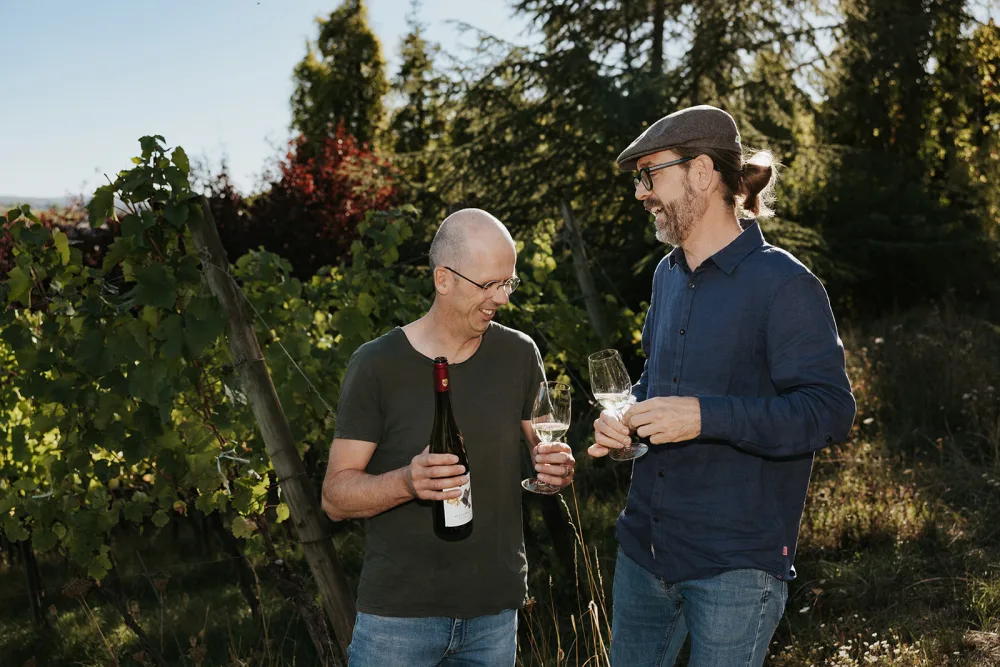
How four wineries between Ahn and Ehnen shape Luxembourg’s Moselle
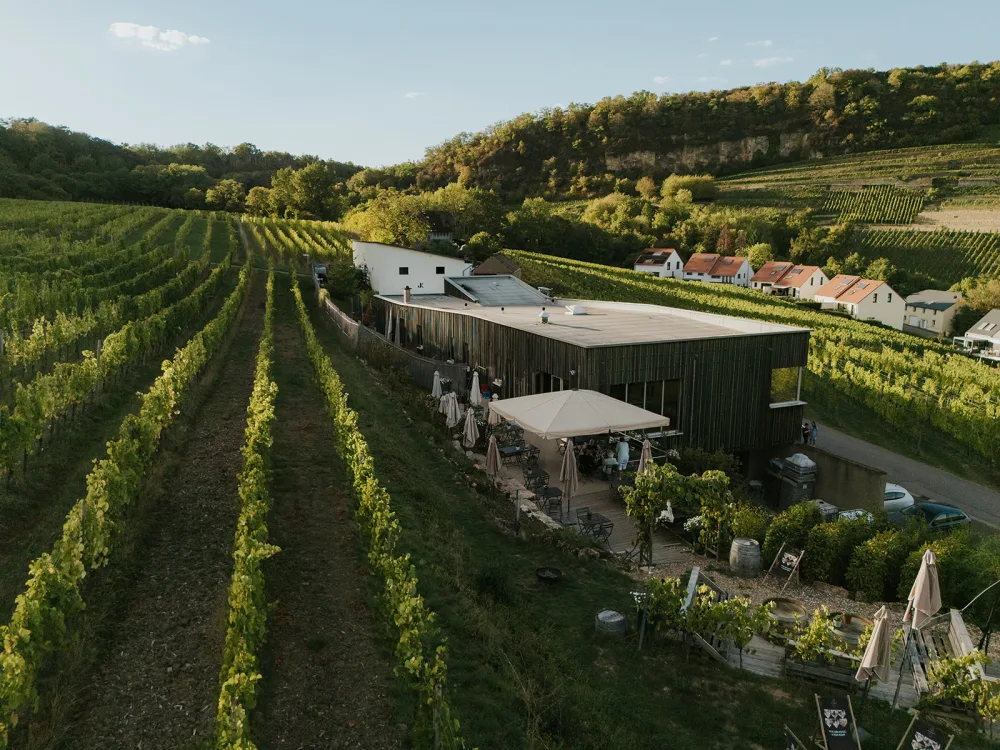
It is a Tuesday in October, and the sun is being kind to Ahn. From the terrace of Winery Jeff Konsbrück, the view stretches from the village rooftops, across the Moselle, to the slopes on the German side. Just below, the Traumschleife hiking trail passes by. By the weekend at the latest, hikers will once again climb the steps, take a seat and linger a little longer – as they have done for years. For now, everything is quiet. The harvest ended weeks ago. It began earlier than ever before along the Moselle, in mid-August, and finished with a third fewer grapes than usual, or even half the normal yield in some cellars. A year in which there would be reason to complain. Yet anyone sitting up here this afternoon hears none of that. Here, it is about what has remained: the view, the wine in the glass and the story of how both came to be here.
Ten minutes upriver, in Ehnen, stands an old winegrower’s house where the parents come for coffee every morning at eight. One village further on, in Wormeldange, a man works in a cellar, although he originally trained as an industrial mechanic. And just a few hundred metres from Jeff’s terrace, a father sits beside his son, telling the story of a mill that has stood still for more than a century. Four houses within less than five kilometres, four different ways of running a winery: as cousins in the eleventh generation, as brothers-in-law, as father and son, and as a founder whose name is still new above the door. Four answers to the question of who shapes this river. And the oldest of these stories lies just a few hundred metres away, 337 years in the past.
The silent mill
Jean Duhr does not have to look far when he wants to tell the story of his family home. He simply points out of the window. Over there stood the miller’s house, built in 1592. The property at the foot of the Palmberg has belonged to his family since 1689, and the mill is still visible on the gable today, although its wheel has not turned for more than a hundred years. It was Jean’s grandfather who realised in 1903 that milling could no longer provide a livelihood and gradually shifted the family business towards wine. Yet people in the village continued to call him the “miller”, a nickname that, as Jean adds with a smile, was anything but an insult.
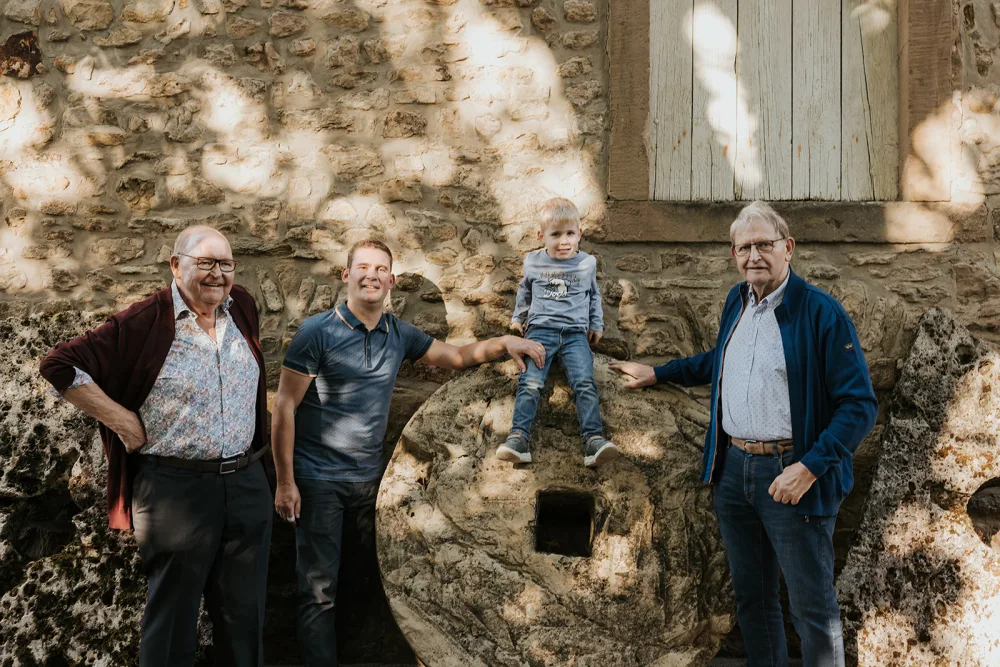
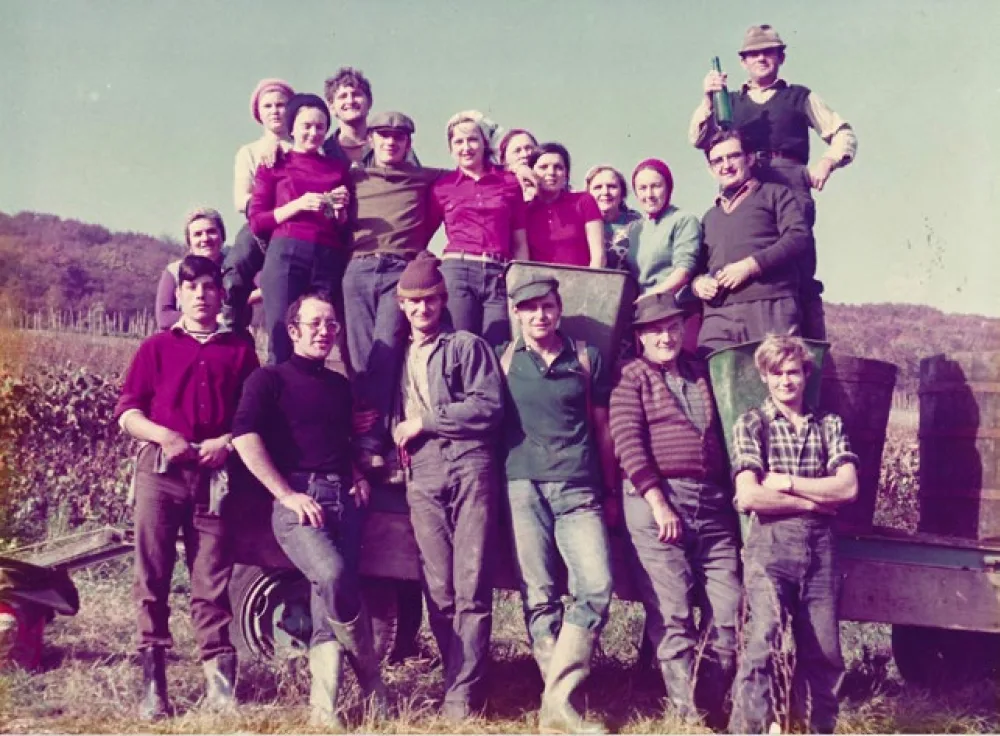
Jean has been involved in the business since 1970, when he took it over together with his brother Paul, hence the name “Duhr Frères”. Listening to him, it quickly becomes clear that the eleven generations impress him less than the changing times in between. He talks about the golden years before the First World War and the end of the customs union with Germany, when, almost overnight, the Belgians became their customers. They preferred more aromatic wines, so in 1932 the family planted the country’s first Gewürztraminer, followed in 1975 by the first Pinot Noir. When it came to Crémant, Jean admits, others were quicker. “But you have to recognise the times. Anyone who follows behind has already missed the boat.” Eleven generations are certainly a source of pride. “But you can’t buy anything with that.”
“You have to know how to keep up with the times. If you’re always playing catch-up, you’ve already missed the boat.”
Since 2002, the winery has been run by the sons of the two brothers, Luc and Frank, cousins who took over their fathers’ responsibilities so naturally that it is hard to imagine things ever being arranged differently. Paul looked after the vineyards; today his son Luc does the same. Jean was the cellar master; today it is his son Frank. “There was no discussion. It just happened naturally,” says Frank. His father adds that he never particularly enjoyed sitting on a tractor anyway.
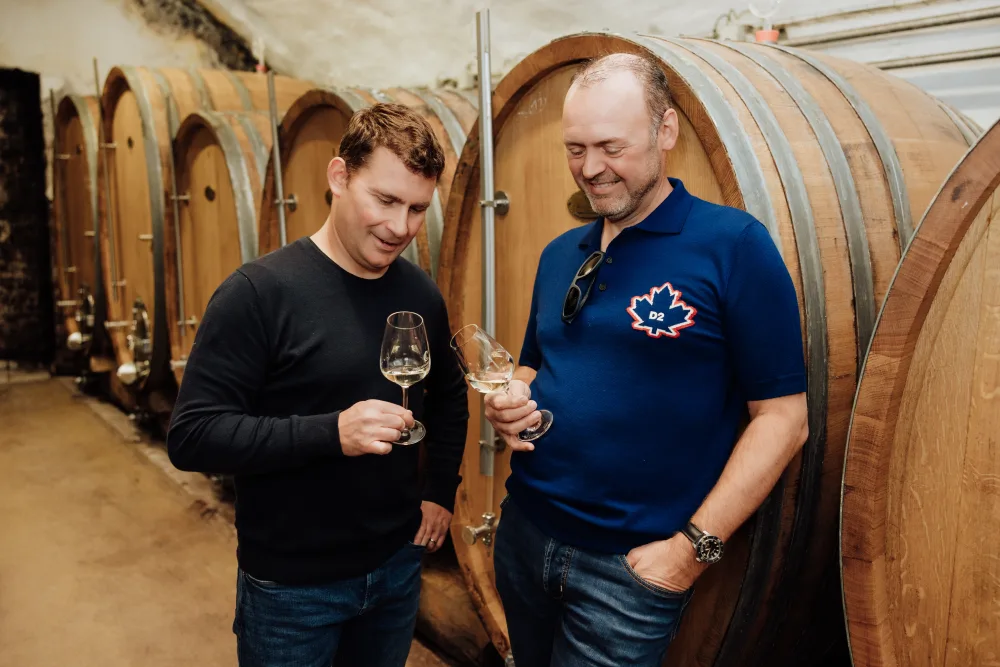
Discussions are more likely to concern what is new. This spring, they planted Sauvignon Blanc for the first time, while a 2020 Riesling is resting in the cellar, soon to be released as “Onzième Génération”, a cuvée produced only in exceptional years. There are no plans to expand the winery. They cultivate just under 15 hectares, “and we’re happy with things as they are,” says Frank. He experienced the early harvest as one of the calmest: fewer grapes, shorter days, no pressure. His favourite moment of the year comes afterwards anyway, two or three days after the last day of harvesting, when everything has been cleaned, everything is safely stored away and the wine in the cellar is taking its course. Sometimes, at moments like these, he thinks about his children, who might one day be ready to take over. But he has no intention of pushing them. “We try to lay the groundwork so that it might interest them,” he says. “The rest is their decision.” Until then, the mill wheel remains still. Everything else keeps turning.
All in the same boat
Whenever Luc Kohll and Claude Scheuren make a decision, the conversation almost always ends with the same words, whether the discussion has been short or long: “Then that’s what we’ll do.” The two men are brothers-in-law, and running the winery in Ehnen together was never part of the original plan. Luc returned from winegrowing school in 2002 and took over his parents’ cellar. Claude worked in IT and became involved in the family business through Luc’s sister Sandy, initially helping with the harvest in his spare time, then increasingly often. When his father-in-law asked him in 2007 whether he wanted to join full-time, he agreed for a reason that initially had little to do with wine: the children were young, and working in a family business meant being able to pick them up from school at lunchtime. “That’s what makes a family business,” he says today. Since 2011, the two men have shared responsibility for the winery, Claude handling sales and administration, Luc overseeing production. “He’s more organised; I’m rather chaotic,” Luc says with a laugh. “But in the cellar, I’m meticulous.” Especially when it comes to Riesling, which both men describe as the king of white wines: mineral, fresh, full of finesse and capable, in good years, of ageing in the cellar for ten years or more. Yet anyone wanting to understand the character of the winery in a single glass is served the Crémant Cuvée brut. “Lively, fresh, but with substance,” says Claude. “That’s us.”
From the outside, the old winegrower’s house has retained the charm of a century ago. Inside, however, it opens into a bright, beautifully renovated “Wäinhaus” that, together with the wine, gently persuades visitors to stay a little longer. It is also a house where the day begins at eight, over coffee, usually with four people around the table, Luc explains. His parents, Raymond and Marie-Cécile Kohll-Leuck, built up the business. They now live in a house of their own but still come by every morning. It was also around this table that the family arranged the succession, early on and with all three siblings involved. “This is where many family businesses fall apart,” Luc says, and it is clear how much he appreciates what his parents did. Claude puts it his own way: “We’re all in the same boat. And nobody is lowering the lifeboats.”
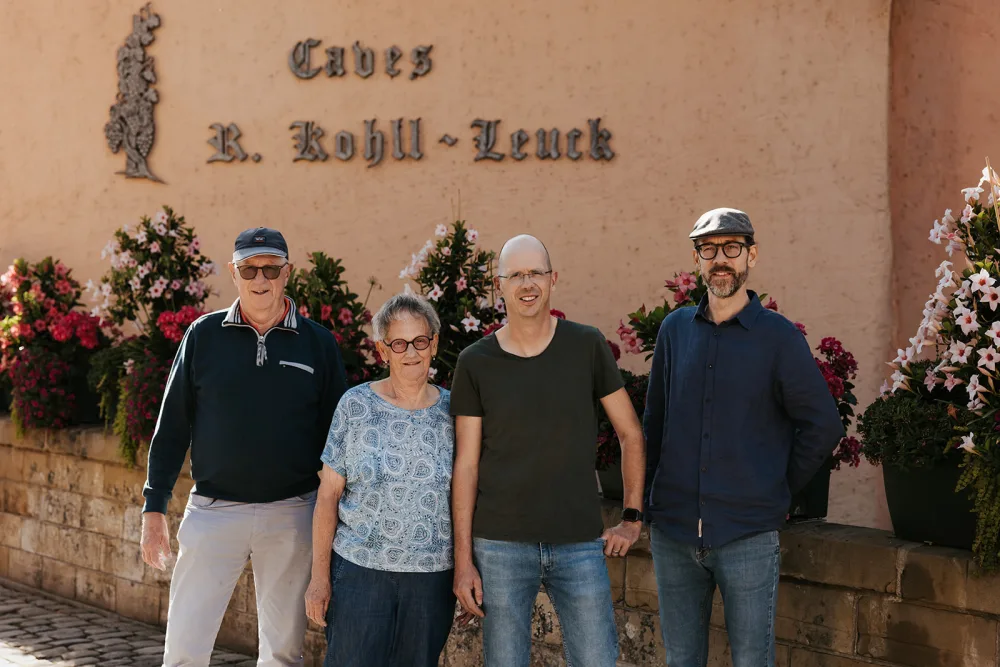
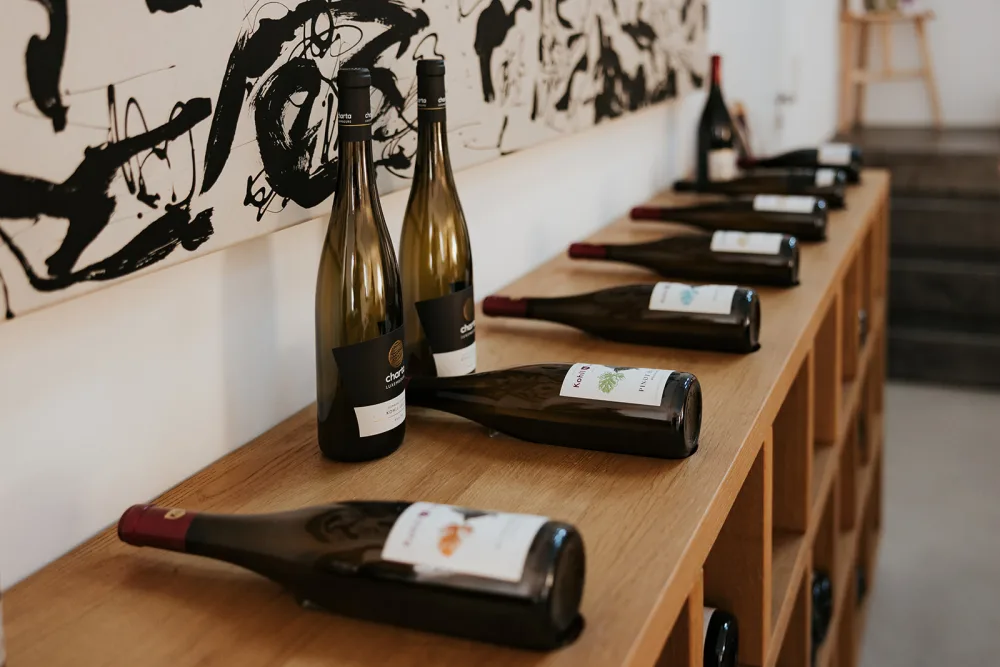
“We’re all in the same boat. And no one is lowering the lifeboats.”
Every autumn shows just how true that is. During the harvest, which began on 1 September this year, Marie-Cécile still leads the team, while Raymond drives the tractor – “only the jobs he enjoys,” Luc says with a smile. He ranks this vintage among the three best of the past twenty years. Claude’s son was there too, lending a hand despite being a student. First the harvest, in his spare time – exactly how things started for his father. And before you know it, you find yourself sitting at that table at eight in the morning, with no plans to leave anytime soon.
The detour
Ask Tom Schumacher what he hopes his winery will look like in fifteen years, and he answers without hesitation. “The children will be running the place, and I’ll be the ‘Bopi’, the granddad who still lends a hand. That would be my dream.” The reason he knows so clearly what he wants lies in his own journey, which was anything but planned. He had wanted to become a winegrower for as long as he could remember. But when the viticulture class finally started at the agricultural school in Ettelbruck, it was cancelled after just three weeks: too few students, too expensive. So Tom trained as an industrial mechanic, worked shifts and saw the vineyards move further away. Until the first day of a harvest when his father, then just 43, suffered a heart attack. Tom stepped in because someone had to. And he stayed because he enjoyed it. “In a way, I was a career changer in my own family business,” he says with a smile. The winegrowing school in Trier accepted him nevertheless, and when he talks about those years today, he recalls the car journeys with other young Luxembourgers, including Luc Kohll and Frank Keyser from Ehnen, during which he says he learned more than he did in the classroom.
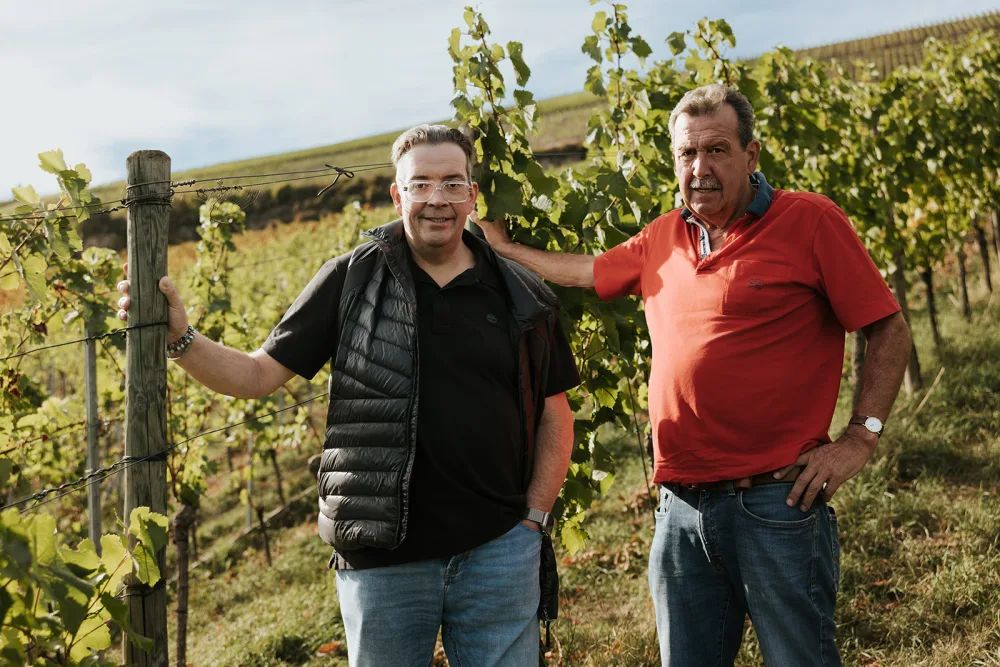
“The children take over the business, and I’m the grandpa who still lends a hand. That would be my dream.”
With such a demanding father, someone who speaks his mind directly and is usually right, taking over was not always easy. Twenty-five years later, Tom is grateful for every stage of the journey. Their relationship is better than it has been for a long time, and his father still takes care of the vineyards entirely on his own. “I’m glad he’s here,” Tom says. Together, in 2010, they moved the winery from the village down to the Moselle road in Wormeldange, where passing visitors now stop. Above them on the hillside lies the Koeppchen, the country’s most famous vineyard site. “It would have been cheaper at the back of the village,” Tom says. “But not necessarily better.”
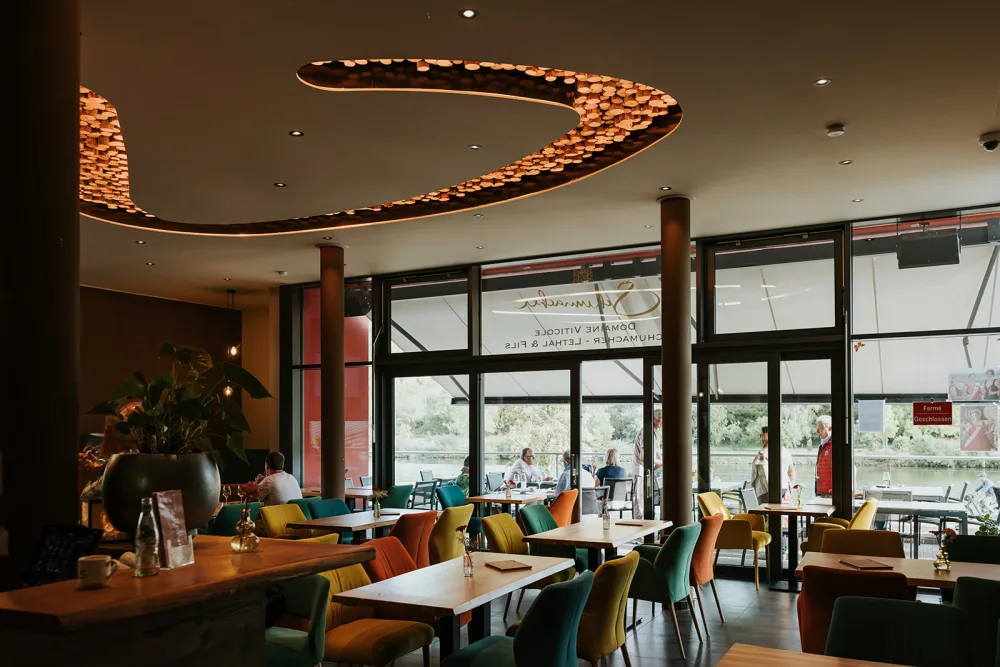
Red wine is one of the ways Tom has put his own stamp on the winery. It all began with a lack of space: there were not enough tanks for Pinot Noir, so Tom planted Pinot Noir Précoce, which ripens three weeks earlier, allowing the same tank to be used twice. That is how innovation happens in Wormeldange. He brought the Blauer Zweigelt grape variety back from an après-ski trip to Austria. Syrah has also been growing here for seven years, and one day he hopes to bring all three varieties together in a red wine cuvée aged in wooden barrels. “But the vines still need a few more years.” When you plant today, you get the best from the vines ten years later. By then, Tom will be almost 60. He planted them anyway.
In Wormeldange, the saying goes that the harvest begins once the “Riesling Open” is over. This time, Tom had almost finished before it even started. He left the last rows hanging, enjoyed the weekend celebrations with the village and harvested the Syrah on Tuesday.
Big windows
Back on the terrace in Ahn, the sun has moved lower over the German side, and Jeff Konsbrück pours a Riesling grown up there on the Palmberg, the slope directly above the village. He makes four wines from this site: a Blanc de Noir, a Pinot Noir, a Pinot Gris and this Riesling. Anyone wanting to understand what he is trying to achieve here should taste precisely these wines. “They contain the minerality of the Palmberg,” he says. “That’s my centrepiece.”
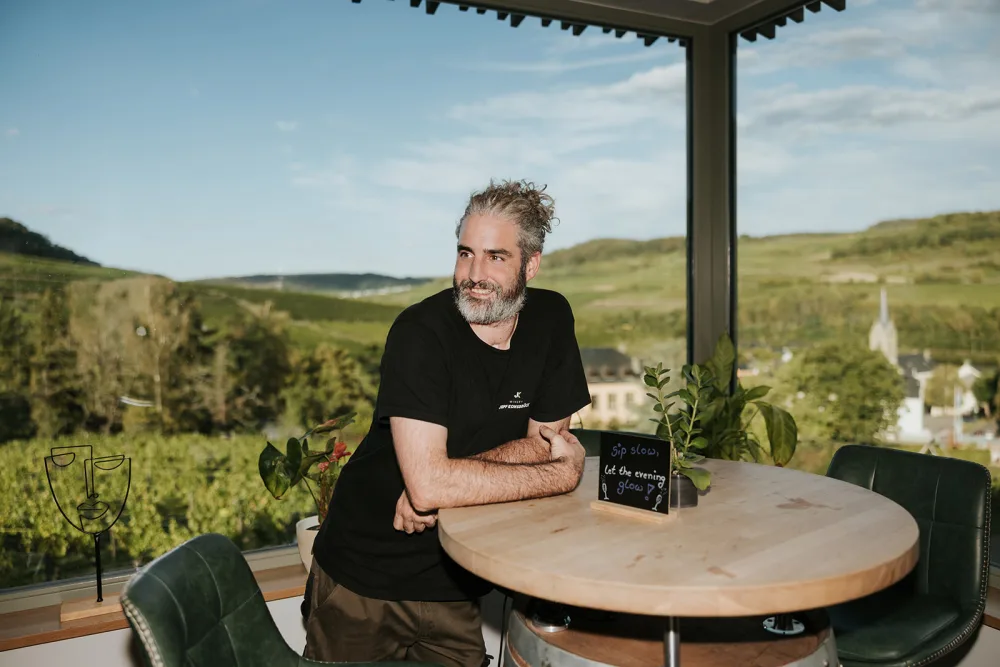
The reason this winery exists in its present form goes back to a conversation Jeff had with his father when he was in his mid-twenties. Guy Konsbrück had always sold his grapes, and when he asked his son whether he wanted to take over the vineyards, Jeff said yes, but only on the condition that he could make the wine himself. His father advised him to work for a few years first and earn some money. Jeff did not want to wait. He would rather fail at 25, he thought, than start at 40, when his father would be over 70 and no longer able to help. He made his first wine in the cellar of a fellow winegrower in the village, opened his own winery in 2014, and his father, who had advised against it, still works alongside him in the vineyards today. “Other wineries are happy when a new customer comes in,” Jeff says. “I was happy when a customer came back.”
“Other businesses are happy when a new customer walks in. I was happy when a customer came back.”
He built the winery out of wood because he wanted a building that fitted into its natural surroundings. And when he stood up here with an architect friend, looking out over the Moselle, the most important decision was made quickly: big windows. The terrace became his strongest argument. “When people tell you the wine is good, it’s always nice to hear,” he says. “But when they say the wine is good and the view is incredible, that makes me even happier straight away.”
Since this summer, Jeff has also been president of Luxembourg’s “Privatwënzer”, a young leader for an association celebrating its sixtieth anniversary this year. One simple figure is particularly on his mind: of the 43 litres of wine consumed per person in Luxembourg, only nine come from Luxembourg itself. He recalls an Italian visitor who was full of praise after tasting a glass of Crémant, while admitting that until then he had not even known Luxembourg produced wine. “How can you persuade someone to drink something they don’t know?” A real challenge for him and his fellow winegrowers.
Glasses in every house
If you ask Jeff, they are competitors, of course. At least in theory. Because if one of them has a flooded cellar, he explains, some of that winery’s grapes can be brought to him until its own roof is watertight again. He knows what he is talking about: that is how he started himself. Frank Duhr puts it even more simply when someone mentions a competitor: “That’s my colleague.” Most of them have known one another since school, sharing the same worries and the same good moments. And when one winegrower stops, they do not simply leave customers behind for the others. They leave a gap. “If you end up standing all alone, that’s not a good thing,” says Jean.
Nowhere is this more visible than at the “Riesling Open”, which Tom so enjoys celebrating before the harvest. For one weekend, the winegrowers of the municipality of Wormeldange open their doors, and visitors move from house to house, from cellar to terrace, enjoying a glass here and another there. Afterwards, every winery has glasses belonging to all the others. And at the next gathering, someone will say: “I’ll bring your glass back.”
The Moselle is getting smaller, and nobody along this river denies it. Yet in these four houses, no one talks about giving up. Instead, they talk about Sauvignon Blanc, a son helping out during the harvest and a red wine cuvée that still needs a few more years. And these are just four among many. Along Luxembourg’s Moselle, just over 60 wineries market their own wines, and behind every sign is another story equally worth telling. So who shapes this river? Everyone who stays. And everyone who comes back to return a glass.